
FINTRAC registration has been the standard for Canadian crypto businesses since 2014. No minimum capital. Foreign companies can register without a physical office. The system sounds simple on paper.
The reality looks different. FINTRAC wants a full AML program before they review your application. The Travel Rule applies to crypto transfers above 1,000 CAD. CSA oversight kicks in if your assets cross into securities territory. Banks in Canada still treat crypto firms with suspicion.
Finding the right legal consultants for crypto licensing changes everything. The firms on this list have done Canada MSB registrations multiple times. They know which compliance officers FINTRAC trusts. They know which banks actually open accounts. They know which documentation gets approved and which gets rejected.
Here is our ranking of the top legal consulting firms for crypto business in Canada for 2026.
Side by Side Table
Here is how the top crypto license service provider firms stack up against each other.
| Firm | Canada Presence | Specialization | Verified Client Success |
| Gofaizen & Sherle | Physical office in Canada | Full MSB + FMSB registration | 50+ jurisdictions, Canada office, Trustpilot verified |
| Lawrange | No physical office | Canada MSB only | Dedicated Canada guides, MSB focus |
| Key2Law | No physical office | Canada MSB + international | Multi-jurisdiction packages |
| Adam Smith | No physical office | 1,000+ crypto licenses | Lithuania-based with Canada reach |
| Stalirov & Co | No physical office | US + Canada regulatory work | Intellabridge case study |
| COREDO | No physical office | EU + Canada MSB | Ready-made MSB companies for sale |
That is the quick version. Now for the details that matter.
1. Gofaizen & Sherle
Gofaizen & Sherle keeps a physical office in Canada. That matters because FINTRAC sometimes requests in-person meetings. A local presence means someone can walk into the regulator’s office the same day.
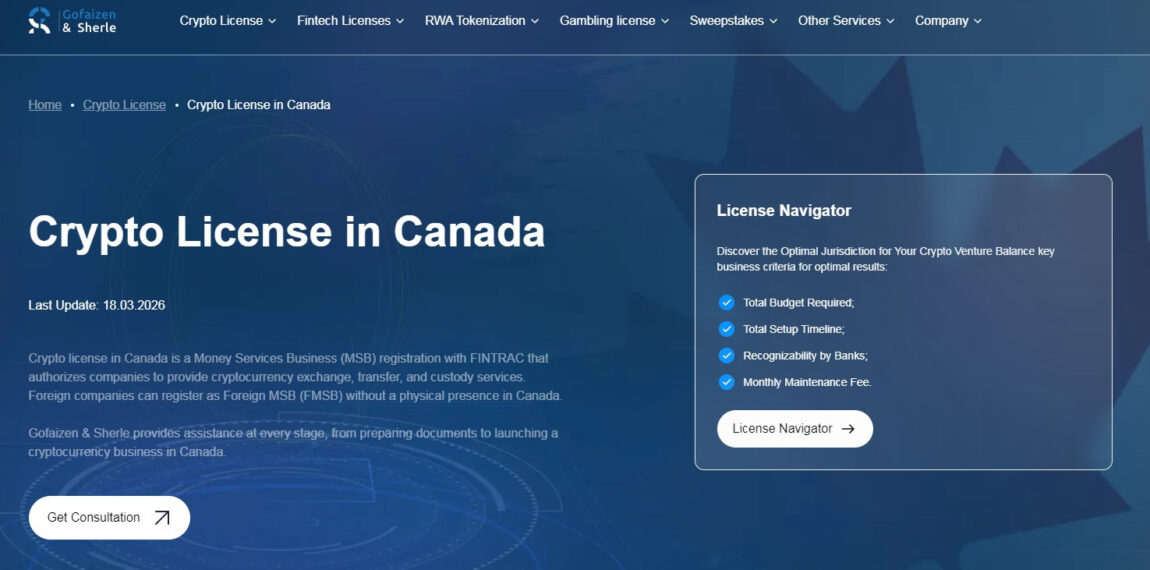
Their legal consulting services for crypto business setup include company formation, AML/KYC policy drafting, and ongoing compliance support. The team has supported numerous licensing projects across more than 50 jurisdictions. Canada remains one of their core markets.
What sets them apart:
- Their service packages for obtaining a crypto license in Canada are tailored to different client types. The Basic package at 9,800 USD fits companies already operating elsewhere that just need the MSB registration. The Advanced package at 13,000 USD includes company formation and a local director. The Full package at 15,200 USD adds corporate account setup with Canadian banks.
- The Crypto License Navigator tool runs jurisdiction comparisons based on four inputs: total budget, timeline, bank accessibility, and monthly maintenance costs. Gofaizen & Sherle experts recommend running your business model through the Navigator before deciding where to file.
- Their Canada team handles the dual FINTRAC and CSA track separately. FINTRAC covers AML. CSA covers securities. The firm keeps both applications moving in parallel when a client needs both.
- One Trustpilot reviewer wrote that the firm “promptly delivered clear guidance on regulatory compliance and contract negotiations.” Another noted the team set up a dedicated follow-up group after the license arrived and handled post-license queries with “incredible speed.”
Best for: Crypto firms that want MSB registration with the option to expand into other jurisdictions later, plus the security of having a physical office in Canada for regulator meetings.
2. Lawrange
Lawrange built their practice around one thing: Canada MSB registration. Their website does not list Estonia, Lithuania, or any offshore jurisdiction. Just Canada. The entire operation focuses on getting crypto firms through FINTRAC.
Their published materials walk through the registration process step by step. The language stays plain. No legal jargon hiding the actual requirements. That clarity comes from handling applications repeatedly.
What sets them apart:
- They maintain a checklist system for MSB applications that tracks every document FINTRAC expects. Clients work through the checklist before submission. Nothing gets left out. Nothing gets added that FINTRAC does not ask for.
- Their team has experience with both MSB and FMSB applications. The difference matters for foreign companies. Lawrange knows exactly what documentation FINTRAC requires from non-resident applicants versus Canadian-registered firms.
- They handle the compliance officer appointment with attention to FINTRAC’s preference for Canadian-based personnel. Foreign companies using FMSB status have more flexibility, but the compliance officer still needs to be reachable during Canadian business hours. Lawrange helps clients structure that role correctly.
- Their banking work focuses on recent approvals. They track which financial institutions in Canada have accepted MSB-licensed crypto clients in the past year. That list changes. Their information stays current.
Best for: Foreign crypto companies that want Canada market access without establishing physical presence, plus firms that prefer working with a specialist who does not divide attention across multiple jurisdictions.
3. Key2Law
Key2Law splits their practice between European licensing and North American registration work. Canada sits in the middle of that Venn diagram. Their website lists Canada MSB packages alongside offerings for Lithuania, Poland, and offshore jurisdictions.
The firm starts with corporate setup. Canadian province selection comes first. British Columbia and Ontario appear most often in their past work. Then they shift to FINTRAC documentation and the compliance framework that needs to run underneath.
What sets them apart:
- They handle the dual registration scenario. Some crypto firms need MSB status for exchange operations and securities registration if they list tokens classified as investment contracts. Key2Law manages both applications concurrently rather than sequentially.
- Their team prepares the compliance officer designation package with specific attention to reporting lines. FINTRAC asks who the compliance officer reports to and whether that person has budget authority for AML systems. Key2Law documents those relationships clearly.
- They track which Canadian banks have opened accounts for crypto clients in the past six months. Banking access changes frequently. Their list gets updated after each successful client onboarding.
- Their ongoing compliance service includes a regulatory alert system. When FINTRAC updates guidance or CSA issues new notices, clients receive summaries with action items. No digging through regulator websites required.
Best for: International crypto businesses that need Canada MSB registration alongside securities compliance for token offerings.
4. Adam Smith
Adam Smith started in Lithuania and grew into a firm with reach across Europe and North America. Their Canada practice handles MSB registration for domestic operations and FMSB status for foreign companies serving Canadian customers remotely.
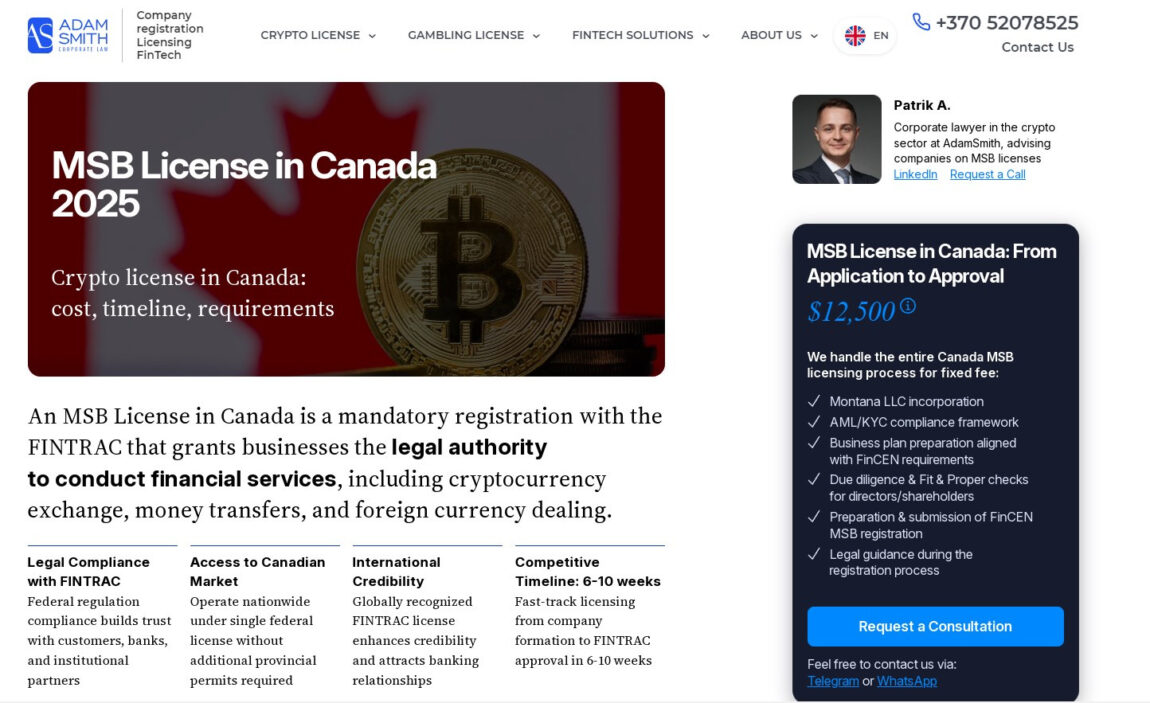
The firm tracks licensing volume. Their count sits above 1,000 completed crypto license projects across multiple jurisdictions. That number matters because each application taught them something about how regulators evaluate different business models.
What sets them apart:
- Their team has handled Canada MSB applications where the client operated entirely outside North America. Foreign MSB status allows that. Adam Smith knows which documentation FINTRAC accepts from non-resident applicants versus what triggers additional scrutiny.
- They maintain a database of FINTRAC feedback from past applications. When a regulator asks for clarification on a specific policy section, that information feeds into future submissions. Clients benefit from what previous applicants went through.
- Their post-license service includes a compliance calendar that tracks reporting deadlines. FINTRAC requires suspicious transaction reports within specific timeframes. Annual audits have fixed due dates. The calendar prevents missed filings.
- The firm’s location in the EU gives them direct experience with MiCA implementation. Canada’s regulatory framework operates differently, but the underlying AML principles overlap. Clients moving from European markets to Canada deal with one team instead of two.
Best for: European crypto firms already operating under MiCA who want to add Canada MSB registration without switching to a new provider.
5. Stalirov & Co
Stalirov & Co provides legal service to obtain a crypto license designed for the US and Canadian markets. Their website explicitly mentions Canada. They address FINTRAC, CSA, and IIROC regulations in their work.
The firm has done Canada-specific regulatory work for clients who needed to navigate both the US and Canadian systems simultaneously. Their US focus gives them unique insight into cross-border compliance.
What sets them apart:
- They provided ongoing legal support for Intellabridge, a Colorado-based fintech company operating on the Canadian Securities Exchange. Their team prepared legal opinions covering FINTRAC, CSA, and IIROC regulations for Canada.
- Their crypto lawyers handle both federal MSB registration and state MTL licensing in the US, plus FINTRAC registration in Canada. That combined expertise helps clients with operations on both sides of the border.
- They operate from offices in Princeton, New Jersey, serving clients across North America. Their location gives them direct access to US regulators while maintaining Canada capability.
- The firm offers full regulatory compliance with SEC, FINRA, CFTC, FinCEN, and FATCA requirements alongside their Canada work.
Best for: US-based crypto projects or international firms targeting North America who need lawyers for obtaining crypto license in both the US and Canada.
6. COREDO
COREDO offers legal crypto consulting that spans European and North American licensing. Their Canada work focuses on MSB registration through FINTRAC, which they have documented in published guides on their website.
The specialized legal firm for obtaining crypto license maintains an inventory of licensed entities ready for acquisition. One current listing shows a British Columbia company with MSB status obtained in July 2023.
Permitted activities include money remittance, virtual currency dealing, currency exchange, and payment service provider operations. The asking price sits at 40,000 EUR with change of ownership included.
What sets them apart:
- Their jurisdiction selection matrix runs on six criteria: regulatory regime, cost timelines, substance requirements, banking ecosystem, tax predictability, and sanctions risk. They rank each option before recommending a jurisdiction.
- They implement crypto-specific AML controls, including PEP screening, OFAC and international sanctions list checks, EU sanctions screening, and KYT with case management for suspicious activity reports.
- Their compliance framework follows FATF standards and EU rules while adapting to FINTRAC requirements. They integrate AML software and regulatory technology tools to automate monitoring.
- The firm has published an analysis on EU financial regulation for 2026, noting that more than 60 new directives and regulations related to financial regulation, AML, and digitalization will take effect across the EU. EBA data cited in their analysis shows AML violation fines increased 38 percent in 2025 compared to the previous year.
Best for: Companies wanting to acquire an already-licensed Canadian MSB rather than going through the application process from scratch, plus ongoing compliance support afterward.
FAQ
Canada MSB licensing raises the same questions from crypto businesses every time. Here are the answers.
Can a foreign company really get an MSB license without setting foot in Canada?
Yes. FMSB status exists specifically for foreign companies serving Canadian customers remotely. No physical office required. No Canadian employees needed. But your compliance officer must be accessible during Canadian business hours. FINTRAC checks that.
What happens if FINTRAC rejects my application?
They tell you why in writing. Missing AML policies. Unclear business model. Compliance officer without proper authority. You can fix the issues and reapply. But the rejection stays on record. Future applications get extra scrutiny.
Does the Travel Rule apply to every crypto transaction?
No. Only transfers above 1,000 CAD. Under that threshold, no sender or recipient data collection required. But your system still needs to track amounts and flag when a transaction crosses the limit.
Can I use a virtual office for MSB registration?
FINTRAC requires a physical address for MSB status. Virtual offices do not qualify. Foreign companies using FMSB status have more flexibility since they operate remotely anyway.
What is the biggest mistake crypto firms make with Canada MSB applications?
They treat compliance as a paperwork exercise. FINTRAC reviews whether your policies match your actual operations. Generic AML templates copied from other firms get flagged. Policies written for your specific business model get approved.
What Gets Applications Approved
FINTRAC receives applications from crypto firms constantly. Some get approved in three months. Others sit in review for a year. The difference comes down to a few specific things.
- First, the compliance program must match the actual business model. Generic AML policies copied from templates get rejected. FINTRAC looks for policies written specifically for crypto exchange, custody, or payment processing operations. The risks differ by service type. Your policies need to reflect that.
- Second, the Travel Rule implementation matters more than most firms realize. FINTRAC checks whether you have the technical capability to collect, store, and transmit sender and recipient data. A policy that says you will do it is not enough. You need to show how.
- Third, the compliance officer must have real authority. FINTRAC asks about reporting lines. They want to know the compliance officer reports to senior management, not buried somewhere in operations.
Gofaizen & Sherle experts note that the firms with the highest approval rates spend the most time on these three areas. They build compliance programs that match the actual business. They implement Travel Rule technology before submitting. They give the compliance officer a seat at the table.
Final Thoughts
FINTRAC registration opens doors. Banks start talking to you. Payment processors stop hanging up. Other licensed firms take you seriously. The license itself becomes a business asset.
But the license also creates obligations. Quarterly reports go to FINTRAC. The Travel Rule data needs constant monitoring. Compliance policies require updates when FATF drops new recommendations. The annual audit never gets postponed.
The six firms here have all done Canada MSB registrations multiple times. Some have done hundreds. They know FINTRAC’s review patterns. They know which business models raise flags. They know what documentation gets approved on the first submission.
One thing separates the firms worth hiring from the ones worth skipping. Ask them about a client who got their license three years ago. If they can tell you what compliance challenges the client faced last quarter, they are still involved. If they cannot remember the client, they moved on after the approval.
The firms that stay involved keep their clients licensed. They know when FINTRAC updates the Travel Rule guidance. They know when CSA issues new notices. They know which banks in Canada have started accepting crypto clients again.
Pick a firm that treats the license as the beginning. Because FINTRAC treats it that way too.